Five Nights at Freddy's
- 4.7
- Rating
- 1.00M
- Installs
- $2.99
- Price

 Analysis by App-foxy
I still remember the first time I played Five Nights at Freddy's on a phone: I expected a simple horror game, but I ended up sitting unusually still, listening for tiny changes and checking screens with the nervous focus of someone trying not to make a mistake. This is an action game from Clickteam USA LLC, yet its action is built around observation, timing, and restraint rather than running around with a weapon. That difference is exactly why it remains so memorable.
The setup is straightforward. You take a night-shift job at a family restaurant and try to survive while the animatronic characters become active. Your office gives you limited ways to monitor what is happening, but every check has a cost. The tension comes from deciding what deserves your attention right now, what can wait, and whether the next movement you noticed is a real warning or your imagination filling in the gaps.
After spending time with the mobile version, I would recommend it to players who enjoy compact horror built around pressure and pattern recognition. I would not recommend it to someone looking for a relaxed game, a story-heavy adventure, or a generous tutorial. The experience is deliberately uncomfortable, and much of its appeal depends on learning through mistakes.
You May Also Like

 Blood Strike: 2.5 Anniversary
Blood Strike’s Loadouts Turn Every Drop Into a Tactical Gamble
A close look at Blood Strike’s custom loadouts: how fast access to signature weapons reshapes its battle royale rhythm, rewards preparation, and narrows the gap between fights.

 Pandora - Music & Podcasts
Pandora’s Music Is Easy to Start, but Harder to Recover
Pandora’s strength is its low-effort path from a seed to a station. Its weak spot is how much confidence it asks you to place in connection, setup, and quiet recovery.

 8 Ball Pool
 Is Built on Rivalries, Rematches, and Routine
A close look at the rivalries, rematches, shared routines, and unanswered safety questions that turn a quick pool match into a persistent mobile community.

 Samsung Music
’s Quiet Strength Is Playing What You Already Own
Its reach comes less from spectacle than from dependable access to a personal library. That simplicity is both the app’s strongest retention engine and its ceiling.

 AccuWeather: Weather Radar
AccuWeather Review: A Quick, Clear Forecast for Everyday Decisions
For everyday plans, the best forecast is the one you can understand quickly. AccuWeather makes rain timing, radar, and local conditions easy to act on, with a few trade-offs.

 Hill Climb Racing
Why Hill Climb Racing Still Turns Crashes Into One More Run
A tiny car, a bumpy hill and one more upgrade: Hill Climb Racing keeps resurfacing because its simple chaos makes every near-miss feel personal.
More From Our News Desk



How the current mobile experience feels
I find the mobile experience works best when I treat each attempt as a focused little routine, not something to play while half-watching another screen. I start by learning the office layout and making brief, purposeful checks rather than trying to track everything at once. That approach makes the pressure easier to understand—and it sets up the small adjustments that can make later attempts feel less frantic.
A small office with surprisingly demanding decisions
The central room is intentionally restrictive. You cannot freely explore the restaurant or physically confront the threats. Instead, you work from a fixed position and use the tools available to understand what is happening outside your immediate view. That limitation could have made the game feel passive, but it does the opposite: because you cannot see everything at once, every decision feels important.
I found the best way to play was to establish a repeatable checking rhythm instead of reacting randomly. A quick look at one area, a glance toward another, and a return to the office creates a mental map of movement. The rhythm is never completely safe, though. The animatronics do not politely wait until you are ready, so a routine that works for one attempt may need adjustment on the next.
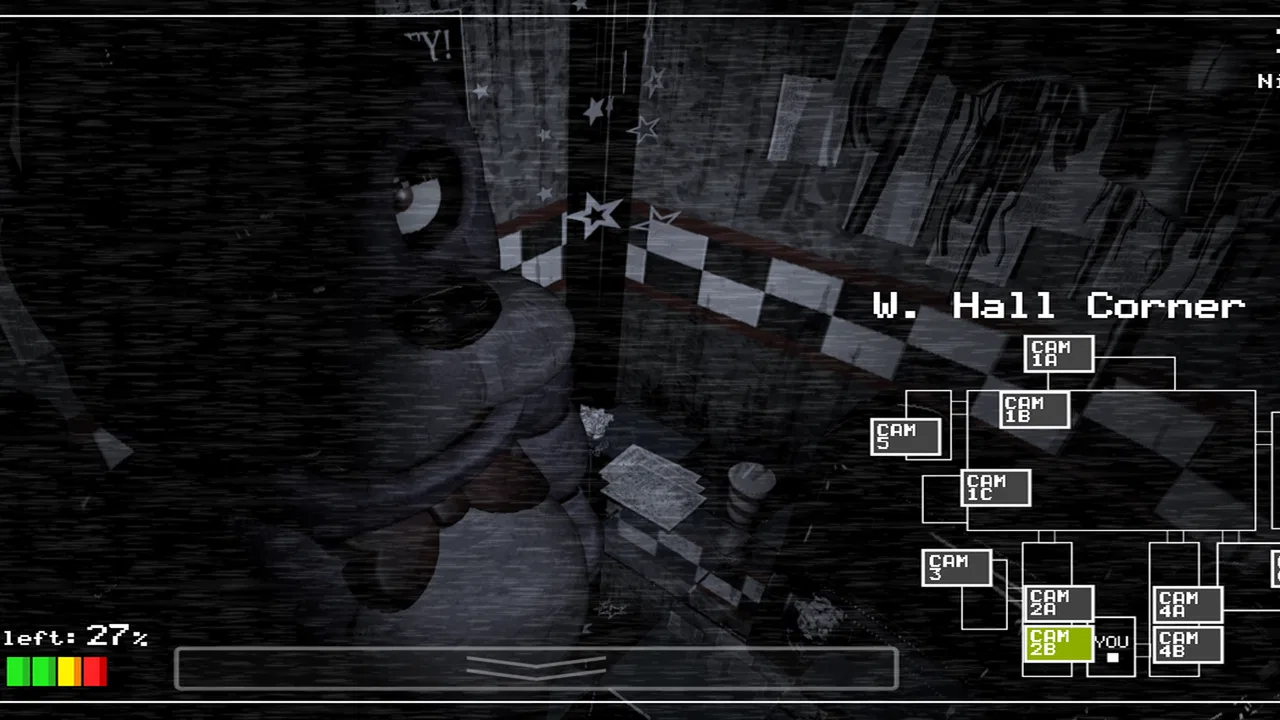
This is one of the game's strongest design choices. It turns ordinary interface actions into meaningful risks. Opening a monitor is not just opening a menu; it is a moment when your attention leaves the office. Checking a camera is useful, but staring too long can make you miss another problem. The game teaches this balance without explaining every consequence in detail.
Why the fear works better than expected
The horror is effective because it relies less on constant visual spectacle and more on anticipation. A quiet stretch can be more stressful than a sudden scare. When I noticed that a familiar figure was no longer where I expected, my mind immediately started calculating possible routes and mistakes. The game makes uncertainty feel like an active threat.
Sound is especially important. Playing without audio removes much of the information that helps you judge danger, so headphones make the experience more readable as well as more frightening. I would still keep the volume comfortable, because the sudden moments are designed to catch your attention. The game is not something I would play casually while a video or conversation competes for the same focus.
The Teen content rating is a useful warning for families. This is not an extreme gore-focused horror title, but it does use disturbing characters, suspense, startling imagery, and a sustained feeling of vulnerability. A younger player who dislikes jump scares may find the experience more stressful than entertaining.
Controls that suit a phone, with a learning curve
The mobile controls are easy to understand once you accept the game's layout. The challenge is not remembering a complicated control scheme; it is performing the right action quickly while your attention is divided. On a smaller screen, the interface can feel more cramped, especially when you are switching between monitoring and defensive decisions under pressure.
I recommend beginning with a short, focused session rather than trying to force a long run. The first attempts are useful for learning where everything is and how quickly you can move between views. Holding the phone steadily also helps. This is a game where a rushed tap can feel like a strategic error, not merely a control mistake.
One practical tip is to avoid treating the camera system as a place to watch the action continuously. It is more useful as a set of brief information checks. Looking for changes, then returning to the immediate threats, keeps the screen from becoming a distraction. That approach also makes the limited resources feel more manageable.
What the version information tells existing players
The current version is 2.0.7, and the game has been available since August 24, 2014. That history matters because this is not a brand-new mobile experiment still searching for its identity. The core design has had time to become established, and the present release represents the version a new player is likely to encounter when deciding whether the original formula still works on a phone.
For someone who already played an earlier mobile release, the sensible expectation is continuity rather than a completely redesigned game. The important question is whether the familiar office-based survival structure remains enjoyable on a modern device, and in my experience it does. The game still depends on the same basic tension: observe carefully, conserve your options, and avoid panicking when the situation changes.
That continuity is a benefit for returning players who want the original experience without learning a new system. It is also a limitation for anyone hoping for a large modernization or a different type of horror. The version number signals an established product, not a promise that the game has been rebuilt around every newer mobile convention.
How updates affect the way I play
For existing users, the most meaningful improvement is not a flashy feature but confidence in the current package. A mature release is easier to recommend when the player can focus on the design instead of wondering whether the basic experience is still being shaped. I can approach each session as a test of judgment rather than as a tour of changing systems.
That also changes how I think about progression. This is not a game I play to collect a large inventory or decorate a profile. My progress is mostly knowledge: recognizing patterns, understanding when a check is worthwhile, and learning which habits create unnecessary risk. If you return after a long break, you may feel rusty, but the game gives you a clear reason to practice again.
The compact structure works well for short evening sessions. I can play a few attempts, stop after a tense failure, and come back later without needing to remember a complicated plot or a large map. At the same time, the intensity means it is not ideal for every spare moment. A quick session can still leave me too alert for bedtime, particularly if I have been playing with headphones in a dark room.
Price, audience, and the value question
The game costs $2.99, which places it in an easy-to-understand position: you pay for the main experience rather than downloading a free trial and deciding later whether the tension is worth continuing. There are also in-app purchases ranging from $0.99 to $4.99 per item. I would consider the base purchase the important decision, because the game's appeal comes from its survival loop, not from treating it like a long-term spending hobby.
With more than one million installs and an average rating of 4.7 from around 163 thousand ratings, it is clear that the mobile release has reached a substantial audience. Those figures do not guarantee that every player will enjoy it, but they match my impression that the formula transfers well to touchscreens. The large number of reviews, around 33 thousand, also suggests that this is a familiar choice rather than an obscure experiment.
For value, I would compare it with other short horror games rather than with large action titles. A bigger game may offer more locations, characters, exploration, or narrative content for a higher price. This one offers a concentrated challenge that can be replayed because your understanding improves. If you want breadth, choose something else. If you want a focused test of nerve and attention, the price is reasonable.
A realistic everyday use case
Imagine finishing work or school, having twenty minutes before bed, and wanting something more engaging than scrolling. You start a night, make a few cautious checks, and fail because you spent too long watching the wrong area. Instead of feeling that the loss was random, you can identify the habit that caused it and try again. That makes the game a good fit for short bursts when you enjoy improving through repetition.
There is a catch. If your household is quiet and you need to remain available for a child, roommate, or phone call, the concentration required can be inconvenient. The game's strongest moments depend on noticing small changes, so interruptions are costly. I would choose it for a private break, not for a situation where I need to divide my attention.
Where it still feels limited
The fixed viewpoint is brilliant for tension, but it can also become restrictive. Players who prefer direct control, exploration, or physical action may feel that they are spending too much time observing interfaces. The game asks you to appreciate limitation as the main mechanic. If that idea does not appeal to you, no amount of atmosphere will fully solve the mismatch.
Learning can also feel unforgiving. The game does not always make every mistake comfortable to understand, and the first failures may seem abrupt. I eventually treated those attempts as information, but players who need clear explanations before trying again may become frustrated. This is a title that rewards experimentation and memory more than it rewards cautious reading.
Another limitation is replay variety. The challenge comes from responding better, not from receiving a radically different activity each time. That is enough for players who enjoy mastering a compact system, but it may not satisfy someone who expects new environments or a constantly expanding campaign. A broader horror adventure would be the better alternative for that audience.
Who should choose a different game
I would skip this one if you dislike jump scares, tense audio, or games where failure is part of the learning process. It is also a poor match if you want a story that unfolds through long conversations and exploration. The setting has an intriguing atmosphere, but the moment-to-moment experience is primarily about surviving the shift, not wandering through a detailed world.
Players with older devices should pay attention to compatibility: the game requires Android 6.0 or later. On a supported phone, the main concern is not whether the concept works but whether the screen and controls feel comfortable in your hands. I would test a short session before committing to extended play, especially if you have difficulty with small touch targets or visual clutter.
It is also worth remembering that this is a paid game with optional purchases, not a completely free casual distraction. I prefer that the entry price makes the decision clear, but people who only install free games may not find the format appealing. The right comparison is a small paid horror experience, not an endless free-to-play action app.
What I would watch in future releases
Because the current release is 2.0.7, I would watch for changes that improve mobile comfort without weakening the deliberate pressure. Better readability, dependable touch response, and smooth transitions matter more here than adding unnecessary decoration. The danger of overhauling the interface would be making the game easier in a way that removes the uncertainty that gives it character.
I would also want any future evolution to respect the original balance between information and risk. If monitoring became too convenient, the player could simply observe everything and wait for a guaranteed answer. The game works because knowledge is incomplete and attention is limited. Any change should preserve that trade-off.
For returning players, the useful question is therefore not whether the game has become a different product. It is whether the current mobile version remains a clean way to experience the original survival challenge. My answer is yes, with the qualification that its age is part of its identity. It feels focused and recognizable rather than packed with modern extras.
My final recommendation
Five Nights at Freddy's remains a strong recommendation for anyone who likes horror that turns observation into a source of panic. I appreciate that it does not need a huge map or a complicated combat system to make a short session feel consequential. The best moments come from small decisions: checking at the right time, resisting the urge to stare, and recognizing when a familiar pattern has changed.
Its weaknesses are equally clear. The experience can be repetitive if you do not enjoy mastery, the controls may feel tight on smaller screens, and the learning curve is not especially gentle. Optional purchases are present, but they are not the reason I would choose the game. I would buy it for the focused challenge and the atmosphere.
In the end, I see this as a good mobile version of a very specific idea: survive by paying attention when fear is trying to make you rush. It is not the right horror game for everyone, but if you enjoy tense retries, compact sessions, and the uneasy feeling that something moved while you were looking away, this is still one of the more convincing choices in its category.
FAQs for Five Nights at Freddy's
01What is Five Nights at Freddy’s about?
Five Nights at Freddy’s is a survival-horror game in which you work as a night security guard at Freddy Fazbear’s Pizza, a family restaurant filled with animated mascots. During each shift, the characters begin moving through the building, and you must monitor security cameras, manage limited power, and close doors at the right moment to survive until morning.
02Is Five Nights at Freddy’s suitable for children?
Although Five Nights at Freddy’s does not rely on graphic violence, it contains frightening imagery, sudden jump scares, disturbing character designs, and an unsettling atmosphere. Younger children or players who are sensitive to horror may find it intense. Parents should review the game’s age rating and consider whether suspenseful gameplay and creepy themes are appropriate.
03How does the gameplay work?
The main gameplay takes place from a security office, where you watch camera feeds to track the animatronic characters. You have access to doors, lights, and other controls, but your electricity supply is limited. Using every tool constantly will drain the power, so success depends on observing patterns, conserving resources, and reacting calmly when danger approaches.
04Does Five Nights at Freddy’s require an internet connection?
The core single-player experience can generally be played offline after the game has been installed, which makes it convenient for playing while traveling or without mobile data. An internet connection may still be needed for downloading the app, receiving updates, or using platform-related services. Availability of features can vary slightly between Android and iOS versions.
05Is Five Nights at Freddy’s difficult for new players?
The controls are fairly simple, but the game can be challenging because enemies follow different movement patterns and your power supply is limited. New players may need several attempts to understand the cameras, audio cues, and timing of each threat. The difficulty feels intentional, rewarding careful observation rather than fast reflexes or constant interaction.
Pros
- Simple controls make the game easy to pick up.
- Distinctive sound cues add tension and reward careful listening.
- Short nights fit well into quick gaming sessions.
- The retro security-camera style creates a memorable atmosphere.
- Limited resources make every action feel meaningful.
Cons
- Sudden scares may be too intense for younger players.
- The camera layout can feel confusing at first.
- Repeated attempts may become frustrating without a clear strategy.
- The game offers limited accessibility options.
- Its dark visuals can make details difficult to see on small screens.

Five Nights at Freddy's
Gallery